
Why a Drop Starts Not with Selling but with Vanishing Liquidity
It seems logical: Bitcoin falls because "everyone started selling." But more often it is the other way around. A sharp drop usually begins earlier — when buy orders quietly disappear from the order book. If no one is willing to buy below price, even a small sale is enough to make price collapse. In other words, liquidity leaves first, and only then does price move. In this article we break down how to see it in advance in the order book (Limit Order Depth).
Two types of levels: obligation and intention
First, it is important to tell apart two kinds of levels on the chart. An obligation is an options wall: behind it are the large player’s real obligations, and it cannot simply be removed. An intention is a limit order in the book: it only shows a wish to buy or sell at a price, and it can be canceled or moved at any moment.
The difference is key: an options wall cannot be faked, but a "wall" of limit orders can be — easily. A large player can place a big buy order to fake support, then instantly pull it as price approaches. It is exactly the disappearance of such "intentions" that starts a fall.
What the order book is and who fills it
The order book (Limit Order Depth) is all the limit buy and sell orders. BID — buy orders (the green zone, demand below price). ASK — sell orders (the red zone, supply above price). The gap between them is the spread. Most of the volume in the book is placed by the market maker, and it is they who decide whether to keep the orders or remove them.
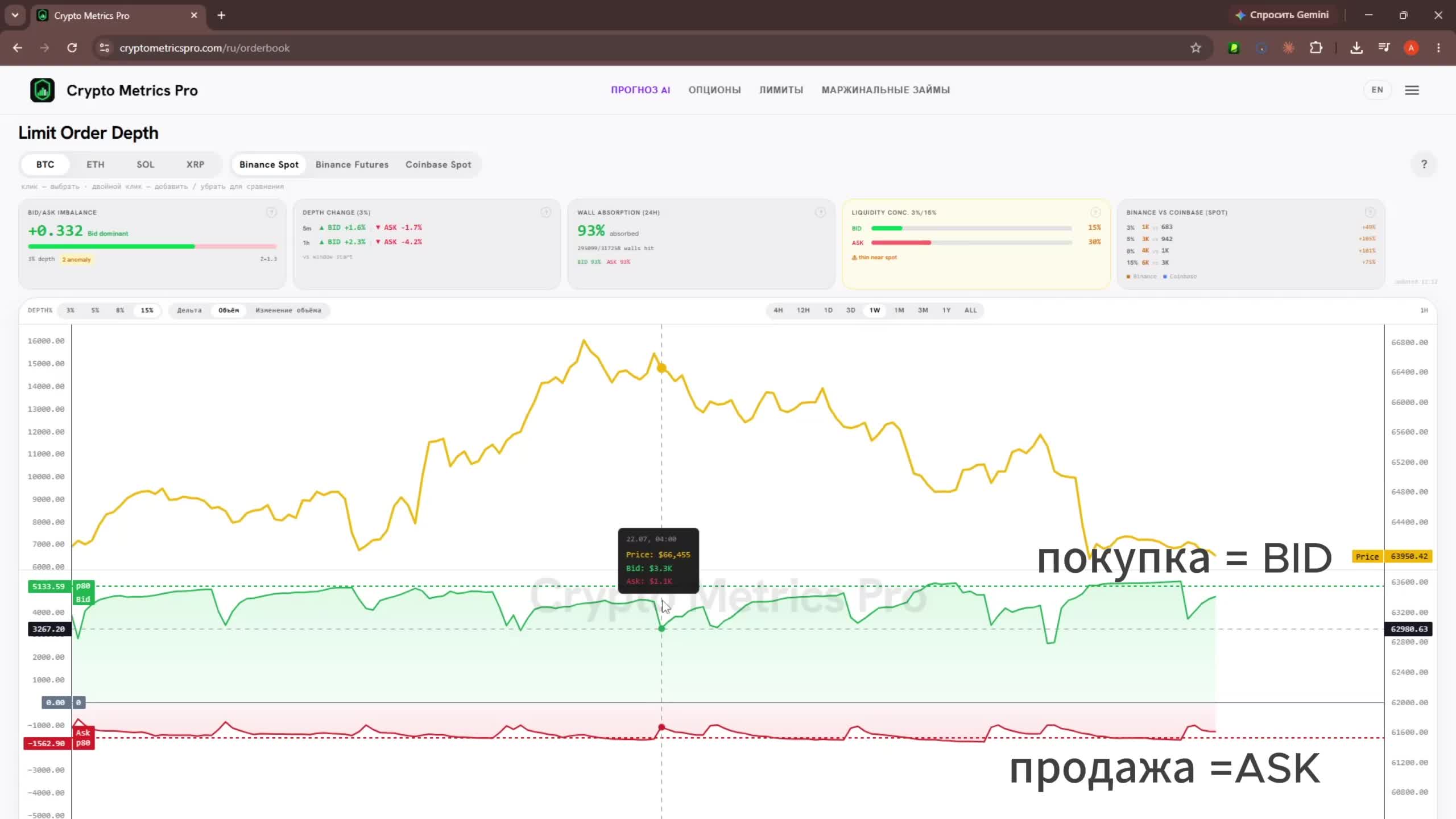
The Limit Order Depth page: the green zone is buying (BID), the red is selling (ASK). Metrics on top: Bid/Ask Imbalance, Wall Absorption, Liquidity Concentration, a "thin near spot" warning.
How liquidity leaves — three stages
Liquidity does not disappear all at once but gradually. It helps to see three stages:
- Reduces size. The market maker shrinks the buy orders — there is less support below price.
- Moves quotes away. The remaining orders are pushed lower: buyers "retreat," and a void forms below price.
- Leaves entirely. The orders are pulled completely — there is nothing left to hold price.
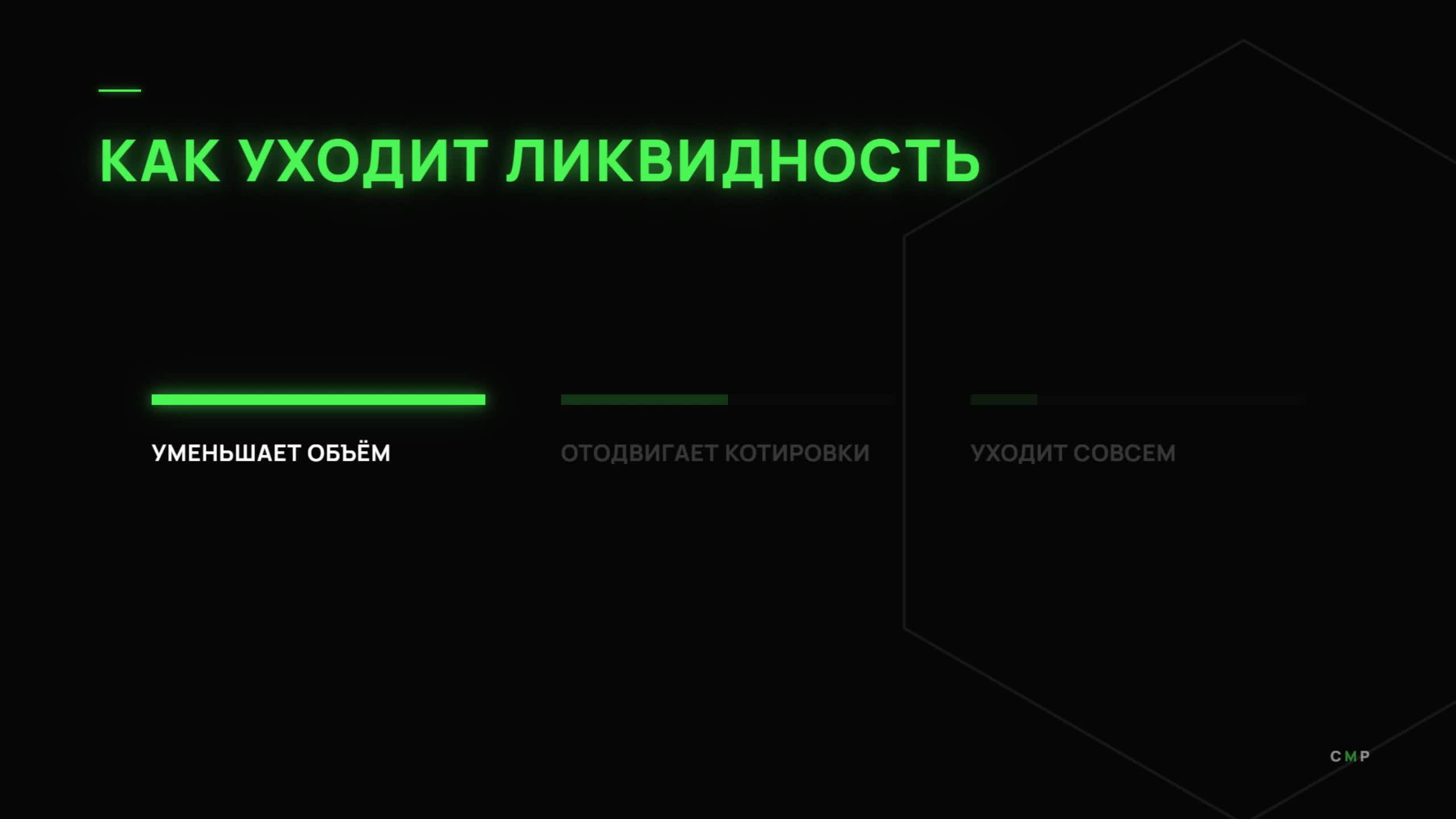
Three stages of vanishing liquidity: reduces size → moves quotes away → leaves entirely.
What came first: liquidity left — then price moved
This is the core idea. First the support below price (the buy orders) disappears, and only then does price collapse. Selling is just the trigger; the real reason for the sharpness is that there is no longer anyone to catch the fall. That is why an experienced trader watches not only the candles but also what happens to liquidity before the move.
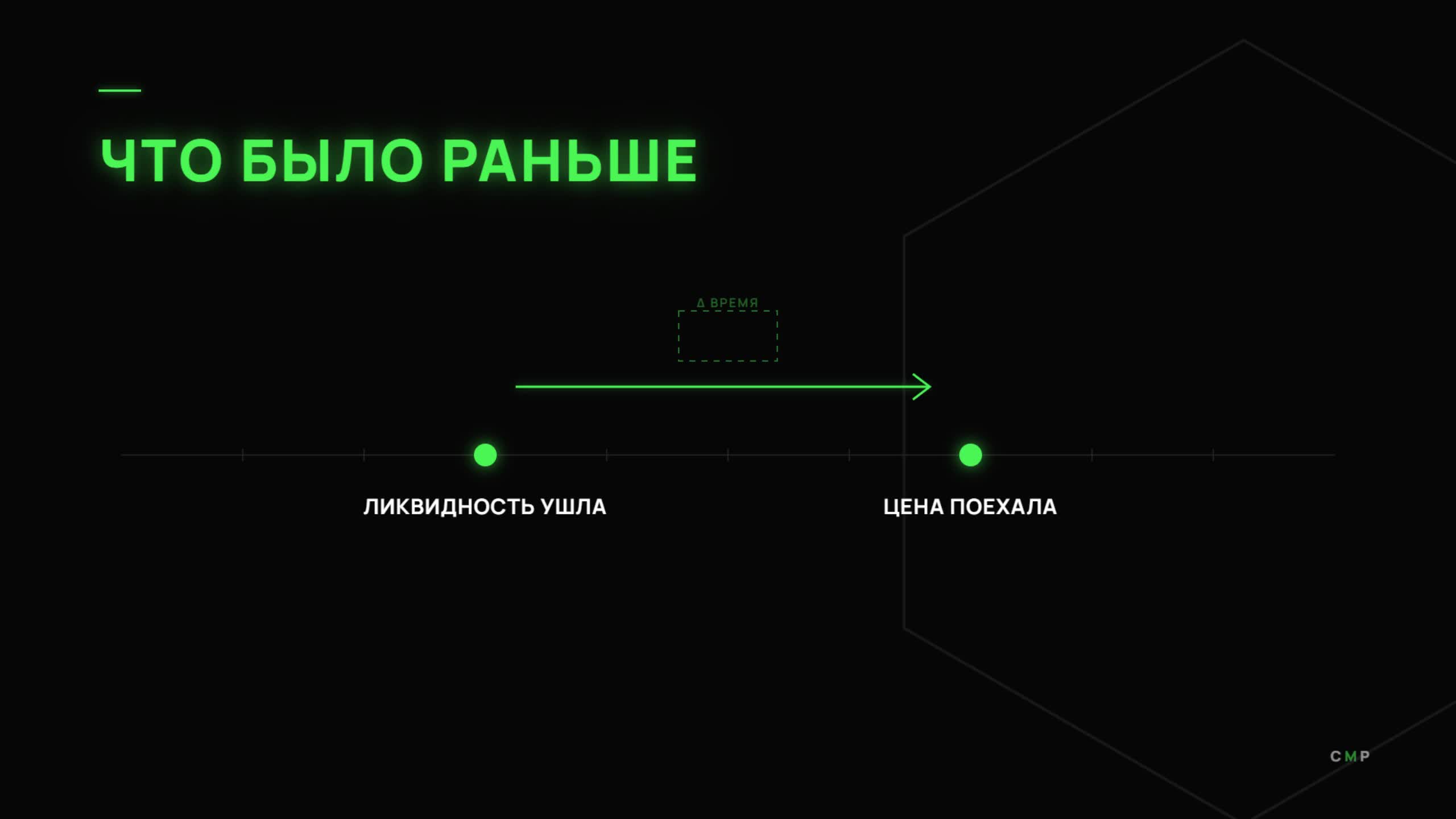
Cause and effect: liquidity left first, then price moved — not the other way around.
What you actually see
The ordinary public order book on an exchange shows only the top — a thin layer of orders right by price. The real depth is hidden and constantly changing. So it is important to look not at the "raw" book but at aggregated metrics that catch vanishing liquidity: how fast depth changes, where demand is thin, how many walls got absorbed.
Separately, remember: options show what the market must do, and the order book shows what is in the market’s way. An options wall sets where price is pulled and where it is defended; the order book shows whether there is support below price right now. Together they give the full picture.
What a beginner should watch in the order book
On the Limit Order Depth page in CryptoMetrics Pro a few readings are enough:
- Bid/Ask Imbalance. Positive — buying dominates, negative — selling. A flip into the negative often precedes a flush.
- Depth Change. A fast drop in BID is a signal that buyers are leaving from below price.
- Wall Absorption. Shows how many large orders got "eaten": if support is actively pulled or broken, there is no base left below price.
- Liquidity Concentration / "thin near spot". A warning about thin liquidity right by price — fertile ground for a sharp move.
Checklist: do not miss vanishing liquidity
- I watch not only the candles but also the order book (Limit Order Depth).
- I tell an options wall (obligation) apart from a limit-order "wall" (intention).
- I track Bid/Ask Imbalance and Depth Change — whether buyers are leaving.
- I see a "thin near spot" warning — I expect a possible sharp move.
- I remember: liquidity leaves first, then price falls, not the other way around.
In short
A drop usually begins not with a wave of selling but with vanishing liquidity: the market maker first reduces the buy orders, moves them away, then pulls them entirely — and only then does price collapse. Options show what the market must do, while the order book shows what is in the market’s way; together they give the full picture. To see how liquidity is behaving on Bitcoin right now, check the Limit Order Depth page in CryptoMetrics Pro.
See BTC and ETH levels live in the Order Book module.
Open moduleMore guides
This material is educational and is not individual investment advice. Trading cryptocurrencies and derivatives carries a high level of risk.