
The Level Bitcoin Cannot Break
You have surely noticed it: Bitcoin keeps approaching the same price — and each time it bounces down, as if it hits an invisible ceiling. The level does not break on the first try; price gets rejected again and again. From the outside it looks like randomness or "chart magic." In fact such a level has a very concrete reason behind it, and once you understand it, you will stop buying right under the ceiling hoping for an easy breakout.
Why the level does not break on the first try
This level is not a random line on the chart. A huge volume of options is piled up on it. When price approaches from below, the large player who has risk here is forced to sell against the move: they slow price down to stop it going higher and to close their risk. Put simply — a big seller shows up on the approach to the level.
That is exactly why Bitcoin bounces off such levels again and again. The level acts as a ceiling (resistance): as long as a large volume stands behind it, every push up meets selling. It is not a reversal "for no reason" — it is a specific level being defended by a large player.
What it looks like on the chart
In the screenshot price approaches the zone (highlighted) and turns down, unable to hold above it. This rejection can repeat several times in a row — that is the "level Bitcoin cannot break."
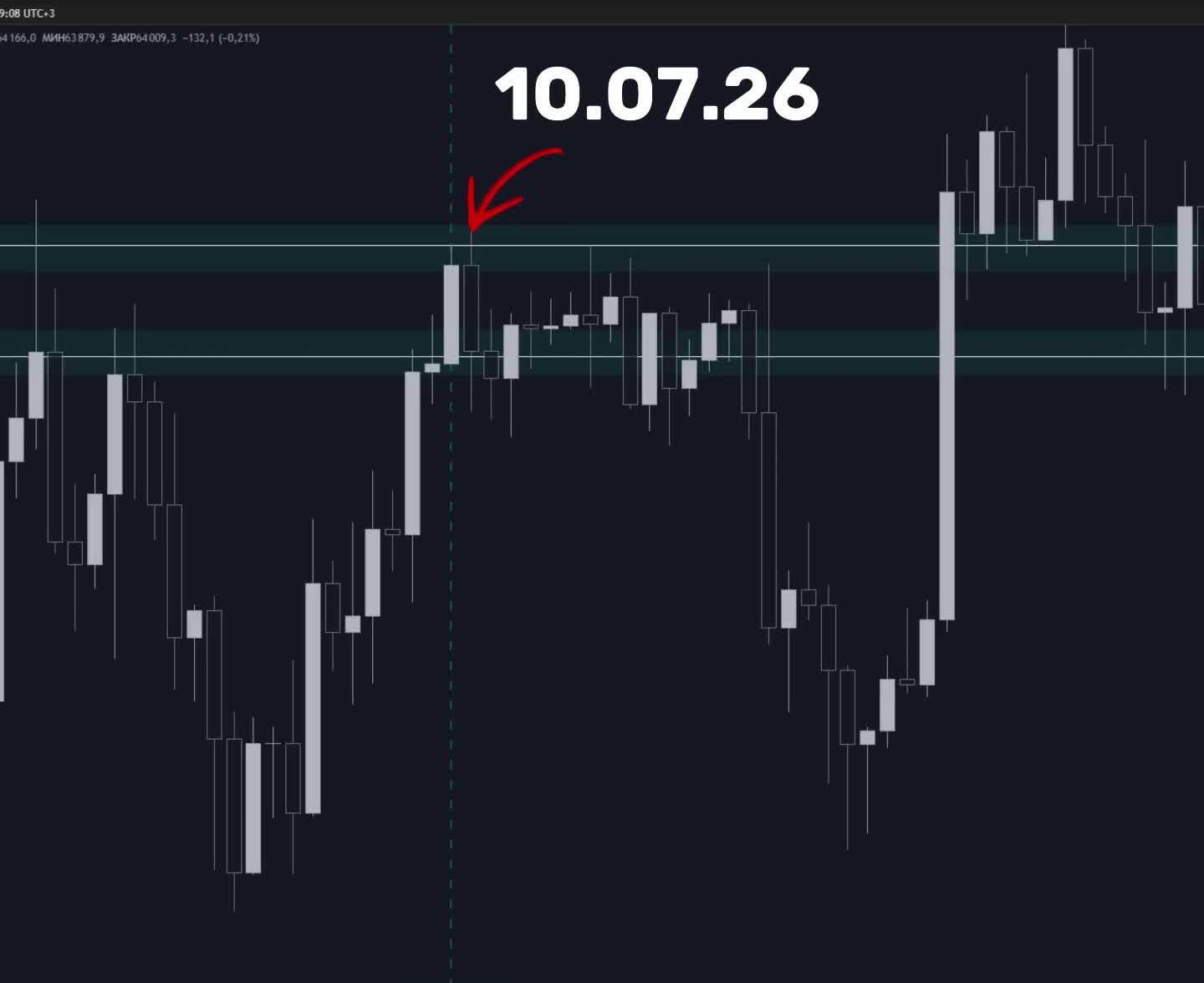
Price runs into the ceiling level and bounces down, failing to hold above it.
Example: where the ceiling sits
The CryptoMetrics Pro dashboard helps you see such a wall in advance. In the screenshot the BTC spot price is around $64,164, and right above it stands the largest options wall, P1, at $64,500. That is the ceiling price gets rejected from. While the wall is there, breakout attempts from below run into the large player’s selling.
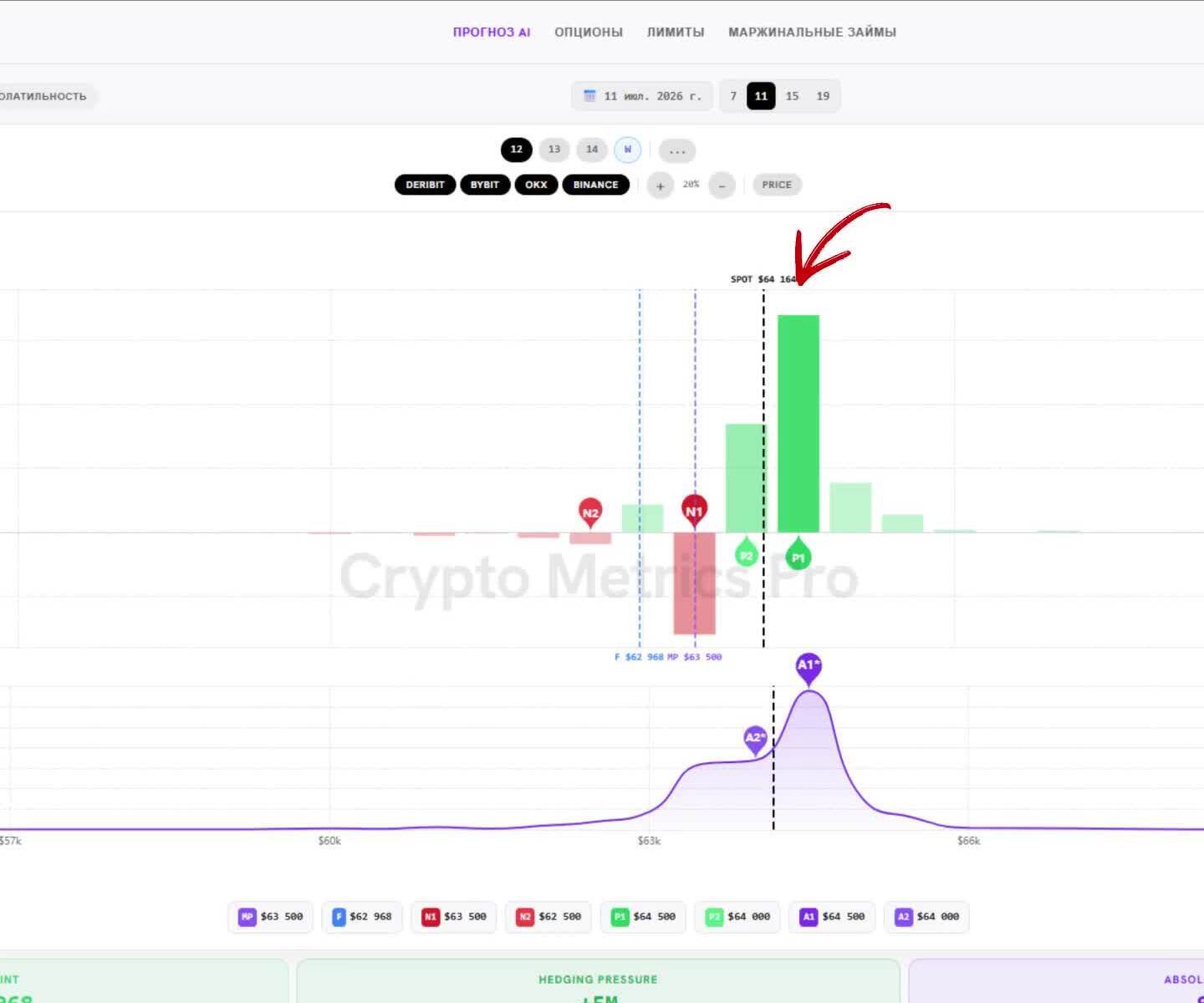
Above spot $64,164 stands the largest wall, P1 $64,500 — a resistance level. CryptoMetrics Pro dashboard.
What this gives the trader
Knowing where the wall sits changes your tactics. Instead of buying right under the ceiling hoping for an easy breakout, you see in advance the level a rejection is likely from:
- Do not go long right under the wall. The nearest resistance often rejects price — the risk of a quick reversal is high.
- Treat the wall as a target for the bounce. If you trade the range, the upper wall is a logical zone to take profit on longs or look for shorts.
- Confirm a breakout, do not guess it. A real breakout is a candle closing with its body beyond the level; and the wall itself "runs dry" after repeated hits or into expiry.
Where to find the levels
All the reference points live on the CryptoMetrics Pro dashboard. As a beginner you only need four readings:
- Options walls (profile bars). The tallest bar above price is the ceiling a bounce is likely from; below price it is the floor (support).
- Flip Point. The line above which the market tends to "accelerate" and below which it tends to "fade."
- Max Pain. The price the market is pulled toward by options expiry.
- Hedging Pressure. Shows whether large players are smoothing the move out or accelerating it.
Checklist before trading at a strong level
- I checked the dashboard: a large options wall stands above price — a rejection is likely.
- I do not buy right under the wall expecting an instant breakout.
- I treat the upper wall as a zone to take profit on longs / look for shorts.
- I count a breakout only on a candle closing with its body beyond the level.
- I remember: while the wall holds, the rejection can repeat again and again.
In short
The level Bitcoin cannot break is a large options wall. When price approaches, the large player sells against the move to slow it down and close their risk, so price gets rejected again and again. Do not buy right under such a ceiling — treat it as resistance, and confirm any breakout with a candle close. To see where that wall sits on Bitcoin right now, check the CryptoMetrics Pro dashboard.
See BTC and ETH levels live in the Options · GEX module.
Open moduleMore guides
This material is educational and is not individual investment advice. Trading cryptocurrencies and derivatives carries a high level of risk.