Calendar Put Spread
The same on puts, with a slight downward tilt: price sits at the level now, while volatility and market fear rise later, helping your far leg.
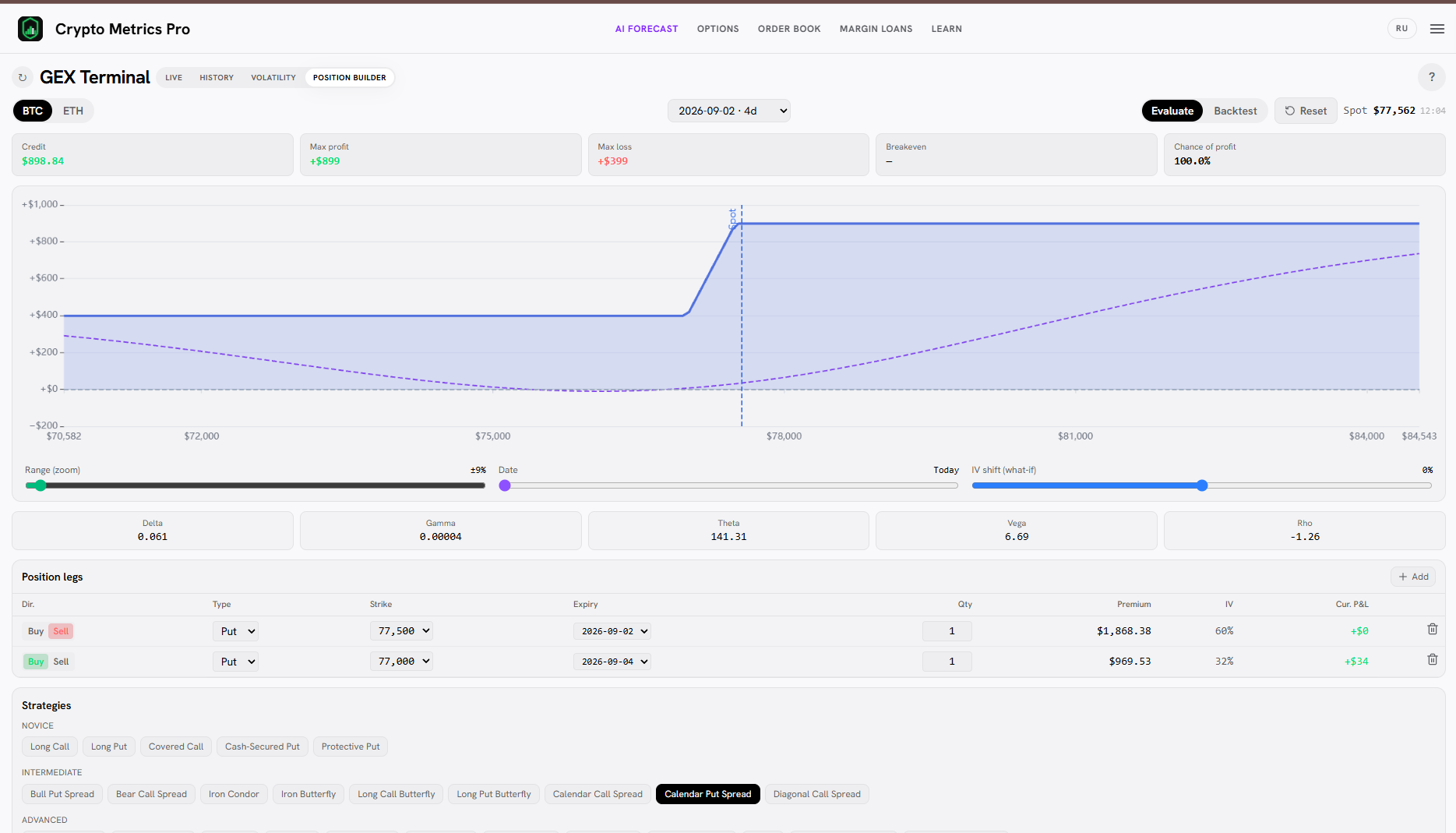
How the Calendar Put Spread works
Like the call version: the near-term put decays faster, and you profit near the strike into the near expiry and on rising IV. The put version suits a mild bearish lean.
Placing the strike at GEX levels
Set the strike where you expect price: at Max Pain or the Put Wall. Best entry is in low IV. The levels are computed live in the GEX Terminal — build it in the Position Builder.
When to open, the Greeks and managing the position
It suits a calm market with a slight bearish tilt, or an expected gentle consolidation at a strong support at the strike. Since a market drop usually lifts IV, rising volatility adds a boost to the far put's profitability. Max loss = debit paid.
Greeks: positive theta and positive vega. Management: the best case is price at the strike by the first expiry; then close or roll into a new calendar.
FAQ
It is built from puts; the same logic, useful for a mild bearish lean.
Capped at the debit paid.
Build the Calendar Put Spread on live BTC and ETH quotes in the Position Builder.
Open the Position BuilderRelated strategies
Information is for educational purposes only and does not constitute investment advice. Options trading carries high risk.