Calendar Call Spread
You expect price to sit near the current level for now, with volatility rising later. You sell the "near" reservation (it burns off fast) and hold the "far" one — earning on the difference in how fast they lose value over time.
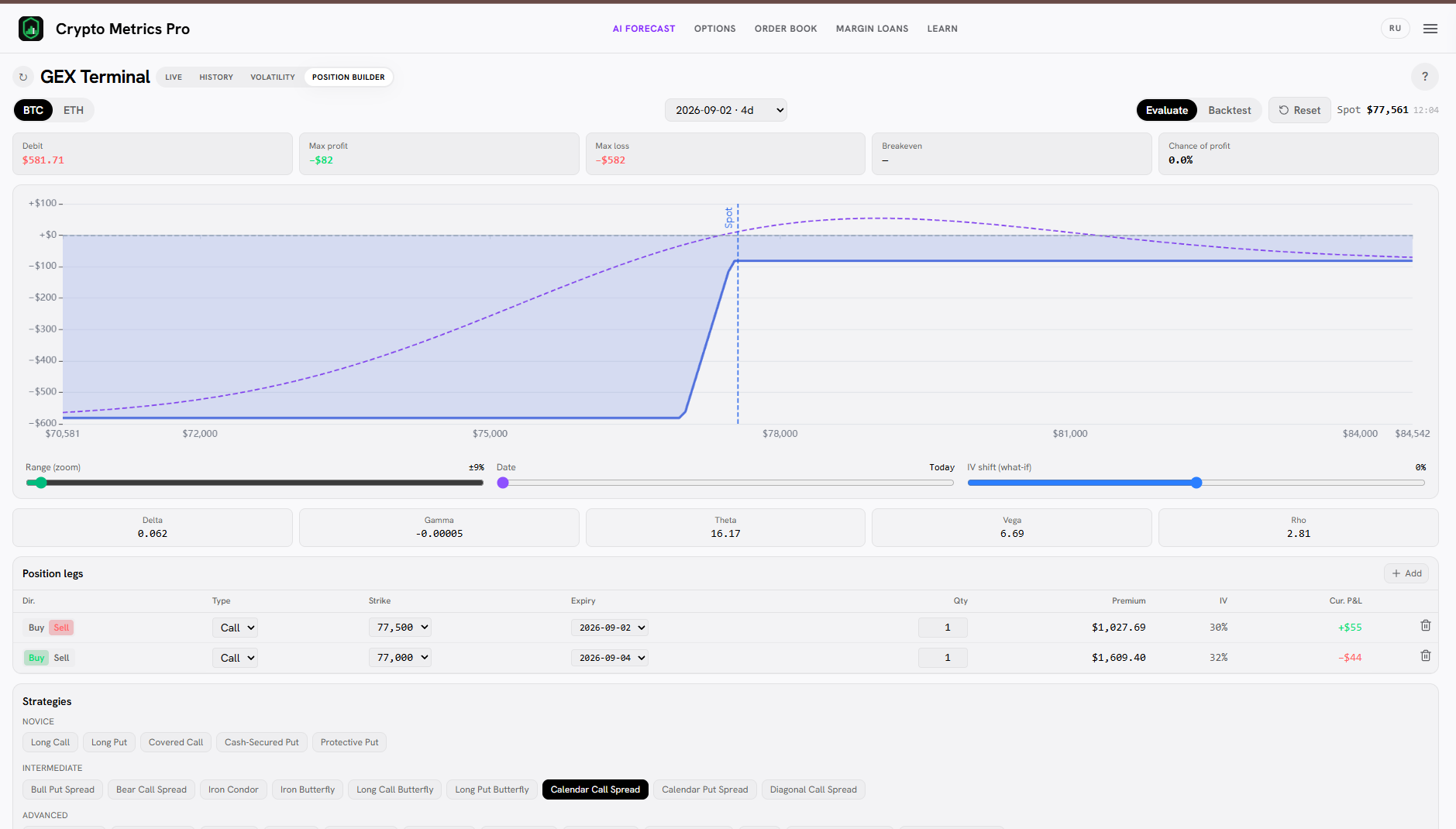
How the Calendar Call Spread works
The near-term call decays by theta faster than the longer-dated one — you profit if price holds near the strike into the near expiry. The position also gains from rising IV.
Risk is capped at the debit paid.
Placing the strike at GEX levels
Set the strike where you expect price into the near expiry — at Max Pain or the Gamma Flip. The best entry is in low IV expecting it to rise.
The levels are computed live in the GEX Terminal — build the calendar in the Position Builder.
When to open, the Greeks and managing the position
Open it on a neutral, stable market. The best environment is IV at historic lows with a rise expected: positive vega helps the far bought option appreciate. Max profit is at the strike at the near option's expiry; max loss = debit paid.
Greeks: positive theta (the near sold option decays faster) and positive vega (the far one is more sensitive to rising IV). Management: after the near option expires, either close or roll into a new calendar by selling the next near option.
FAQ
The faster theta decay of the near-term option and rising IV.
Capped at the debit paid.
Build the Calendar Call Spread on live BTC and ETH quotes in the Position Builder.
Open the Position BuilderRelated strategies
Information is for educational purposes only and does not constitute investment advice. Options trading carries high risk.