25Δ Risk Reversal, Skew & Volatility Smile (Deribit)
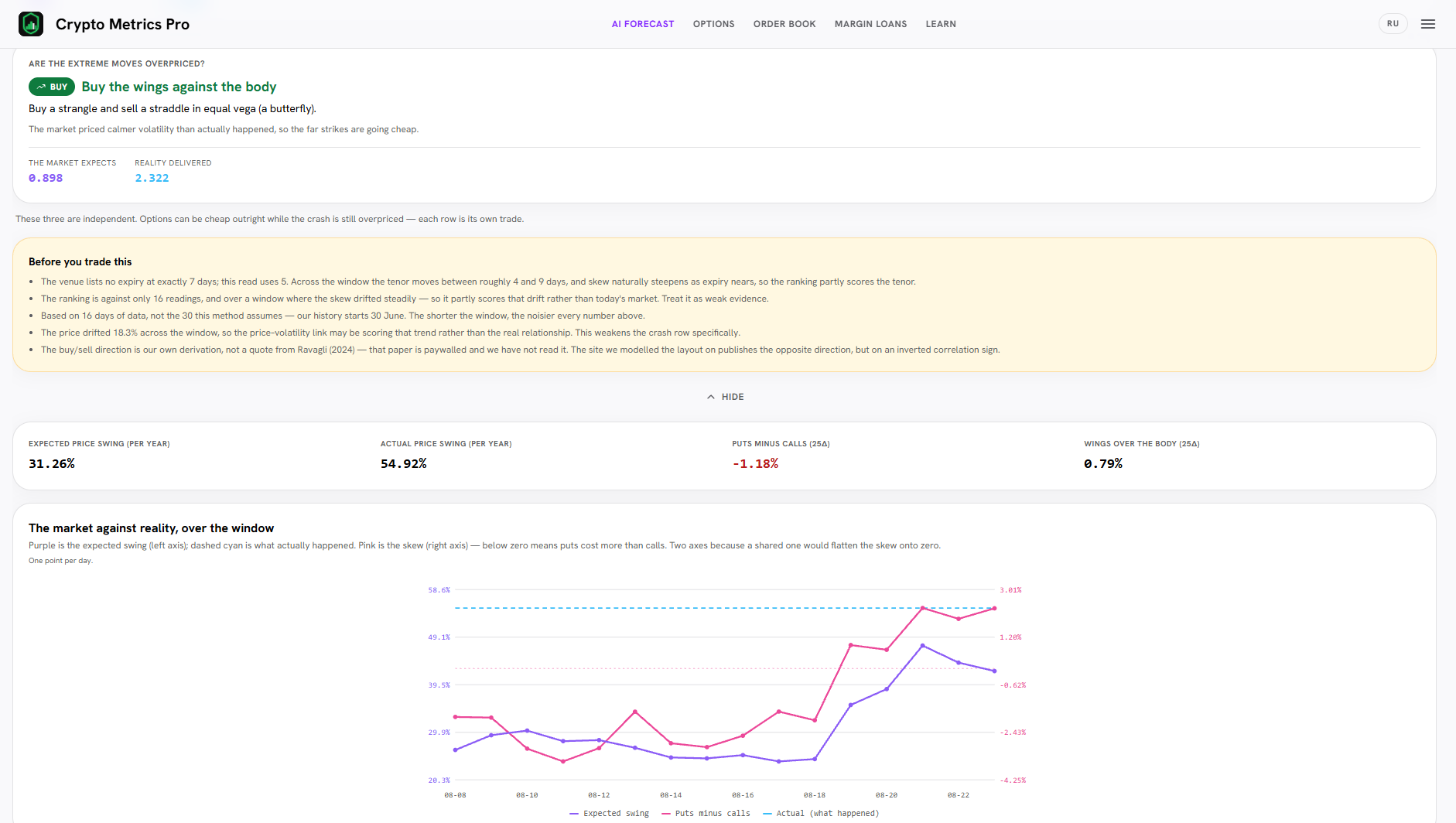
The 25Δ Risk Reversal (RR) measures the implied-volatility skew between 25-delta calls and puts — the price the market charges for tail risk. Below: the formula, how to read its sign, how we compute it across venues, and how RR + GEX read together.
What is the 25Δ Risk Reversal (formula)
The 25Δ Risk Reversal is the implied-volatility asymmetry between the 25-delta call and the 25-delta put at each expiration.
Formula: RR = IV(25Δ Call) − IV(25Δ Put), in volatility points.
How to read the sign
Negative RR — puts are richer than calls. The market is paying up for downside protection (fear, protective hedging).
Positive RR — calls are richer than puts. The market is paying up for upside (bullish speculation, call buying).
Near-zero RR — a symmetric smile; neither tail is especially bid.
How we compute RR (Deribit, Bybit, OKX)
The data source is bid/ask-mid IVs (mark_iv) from Deribit, Bybit and OKX, per expiration and per exchange. Since no strike sits exactly at 25Δ, we linearly interpolate IV between the two nearest strikes that bracket |delta| = 0.25.
When a venue/expiration has wings too thin to bracket 25Δ, it appears as a gap — we do not fabricate a value.
Reading RR together with GEX
Negative RR + negative GEX — dealers are short downside gamma and the market is paying up for puts. A classic amplification setup: a sharp sell-off forces dealer hedging that accelerates the move.
Positive RR + positive GEX — dealers are long upside gamma and the market is buying calls. A rally-into-pin regime: squeezes can happen, but mean-reversion often wins.
Sign mismatch (RR and GEX opposite) — positioning and pricing disagree; watch the flow that resolves the imbalance.
Why RR differs from the P/C Ratio and GEX C/P
The Put/Call Ratio measures open-interest positioning (who owns what). GEX C/P measures the gamma bias (where hedging pressure sits). The 25Δ RR measures the price the market charges for tail risk — it is the vol side of the same question.
In Crypto Metrics Pro, RR and skew live in the Volatility tab (Vol Lab) of the GEX Terminal — for BTC and ETH, per exchange and per expiration.
Glossary terms
FAQ
The IV difference between the 25-delta call and put: RR = IV(25Δ Call) − IV(25Δ Put). Negative means demand for downside protection; positive means a bullish skew.
The Put/Call Ratio is open-interest positioning; RR is the volatility price of tail risk. They answer different questions: "who owns what" vs "how much protection costs".
If an option chain's wings are too thin to bracket 25Δ, we show a gap rather than interpolating blindly — to avoid a misleading signal.
See BTC and ETH levels live in the GEX Terminal module.
Open moduleMore articles
Information is for analytical and educational purposes only and does not constitute investment advice. Cryptocurrency trading carries high risk.