Short Put — Selling a Put Option
You're confident price will NOT fall below a certain level, so you sell a "reservation" to sell — getting paid upfront. But if price drops hard, you'll have to buy the asset above market.
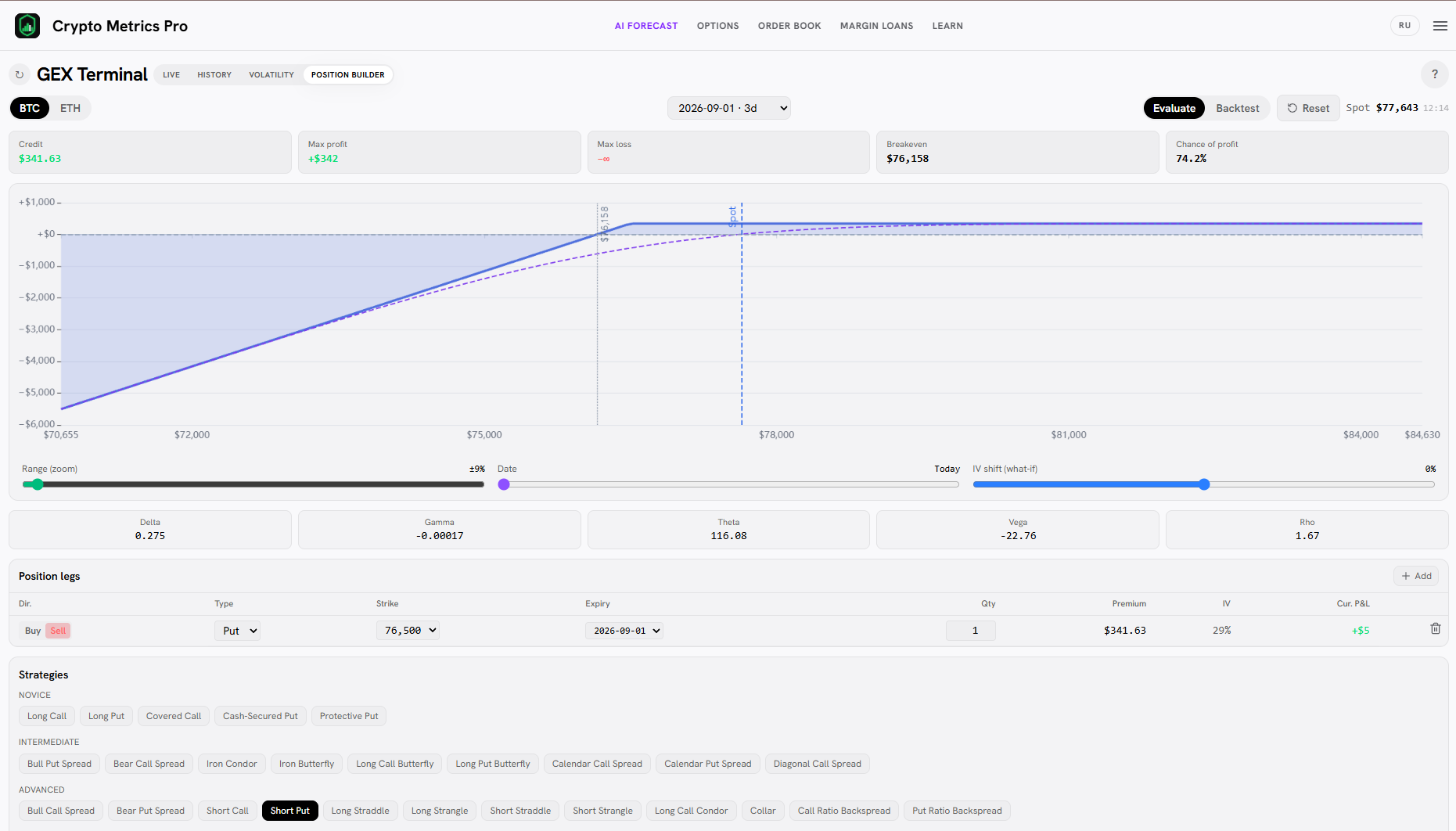
How the Short Put works
If price stays above the strike the put expires and you keep the premium. If it falls, you may be assigned the asset at the strike (effectively cheaper by the premium). Fully cash-backed, this is the Cash-Secured Put.
Placing the strike at GEX levels
Set the strike at the Put Wall (strong support); premium is richer in high IV, the ideal regime is positive GEX. Back it with cash so it is not a leveraged naked put.
The Put Wall is computed live in the GEX Terminal — pick the strike in the Position Builder.
When to open, the Greeks and managing the position
Best entered in high IV when options are overpriced, selling the put right under strong technical support. Max profit = premium, breakeven = strike − premium; max loss is large (down to the asset reaching zero).
Greeks: positive theta makes every sideways day profitable. Management: back it with cash for the strike so it isn't a leveraged naked put; on a break below the strike, roll down/out.
FAQ
The Cash-Secured Put is fully backed by cash for the strike; a naked Short Put uses margin and carries more risk.
The strike minus the premium received.
Build the Short Put on live BTC and ETH quotes in the Position Builder.
Open the Position BuilderRelated strategies
Information is for educational purposes only and does not constitute investment advice. Options trading carries high risk.